Fears of a massive burden
Broadly speaking, the regulations governing plastic packaging aim to reduce waste volumes, promote recycling and encourage a more sustainable use of resources. But a complex and increasingly opaque system of European, national, and local regulations has evolved in practice, one that is characterized less by environmental effectiveness than by growing bureaucracy and significant additional costs.
The controversial “plastics tax” is becoming a massive threat to small and medium-sized enterprises in Germany. Until now, the federal budget has covered the annual costs of approximately €1.3 – 1.4 billion. But current plans by the federal government envisage shifting these costs directly to the manufacturers and importers in order to plug holes in the budget.
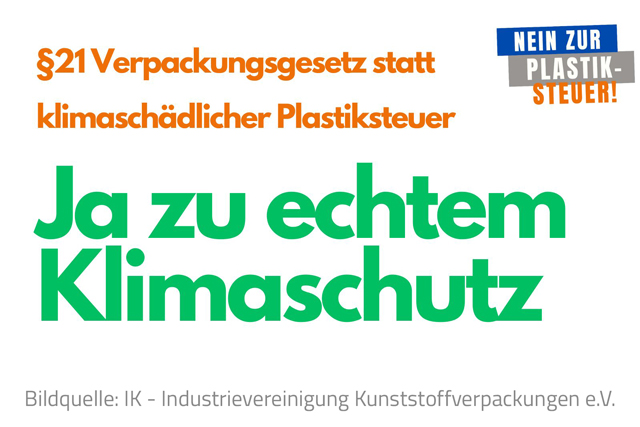

This represents a significant additional burden that could even threaten the very existence of companies in the plastics processing industry. Manufacturers of plastic packaging are already grappling with licensing fees payable to dual systems as well as levies under the Single-Use Plastic Fund Act (EWKFondsG). The proposed plastics tax of €0.80 per kilogram of non-recycled plastic would create yet another significant burden. It is reasonable to assume that these costs will be passed down the value chain – ultimately affecting the end consumer.
One example aptly illustrates the magnitude of the problem: in the worst-case scenario, a medium-sized manufacturer with annual revenue of €100 million would be left facing a payment of up to €25 million in plastics tax. It would not be possible to generate this amount from ongoing business operations, so it would have to be passed on. Yet it will significantly affect a company’s liquidity nonetheless. After all, the plastics tax will be due in the form of monthly advance payments. Given industry-standard payment terms of 60 to 120 days, this would mean that several million euros would have to be prefinanced month for month, thus creating a significant financing gap that many companies would no longer be able to bridge.
The consequences would be serious: plant closures, the relocation of production abroad, job losses and – last but not least – a decline in government tax revenue. Known for its innovative strength, reliability and long-standing experience, the plastics processing industry in Germany would then be left facing one of the most serious threats it has encountered in recent years. And the industry would not be alone: if plastics are no longer processed, there will no longer be a need for machine and tool manufacturing or indeed for plastics production itself.
Here at Fernholz Verpackungen, we are therefore calling for the economic realities of small and medium-sized enterprises to be taken into account when designing the plastics tax. We are also advocating for the identification of viable solutions that will ensure our industry’s continued existence and competitiveness.
These include, among others, realistic transitional periods with due consideration of current taxes, along with incentive programmes for investments in recycling technologies and sustainable packaging solutions. This is the only way to strike a balance between environmental responsibility and economic competitiveness.

 powered by